Friday, February 27, 2015

I'm a sap for hobbies

I once read that “collecting” is the most common hobby among Americans. I can buy that, because I collect. Hobbies that is.

I love hobbies. They give me a needed break from the everyday world, allow me to focus both my mind and pocketbook on the trivial and provide for me a unique sense of identity.

But as much as I love hobbies, I have a devil of a time keeping them. My passion for a hobby can be so blinding that it no longer becomes a break from the everyday world, it become my everyday world.

I have, in turns,

· Tended a massive garden

· Captained (and mostly repaired) a wooden boat

· Carved duck decoys

· Tied flies

· Hunted deer, ducks and rabbits

· Trained a dog who hunted as poorly as I did

· Scoured the countryside for letterboxes

· Made fine things (mostly sawdust) in a woodshop

· Photographed wildlife and wildly cute grandkids

· And a couple others I’ve already forgotten

Each of these was MY hobby. While a recreational pursuit is in my focus, I have little doubt that it is the money-sucking avocation to rival my money-generating vocation. I’m at heart a tightwad, but I’ve never had hesitation laying out the bucks for a rototiller, a table saw, a huge camera lens or a 24-foot wooden boat that was probably better suited for fish habitat.

And each was a bargain. I’m quite certain that every dime you spend on a hobby extends your life a day or two. If you work in a stressful job, as I always have, the chance to perform a mindless-but-enjoyable task to please no boss but yourself is respite with a capital “R.”

Which brings me to my latest passion – with a capital “M.” I make sweet and sticky maple syrup.

A few years ago, when Gillian lived in Vermont, she sent to me a small set of “spiles.” A spile is the spigot that you hammer into a maple tree with the expectation that the precursor to pancake heaven will trickle into your bucket. When I visited her that summer, I couldn’t help but buy a whole selection of big, little, plastic and metal spiles from the real Vermonter (plaid shirt, abbreviated vocabulary) at the country hardware store.

Making syrup is not unlike watching comets. Before the big moment, you crave (and buy) every bit of equipment made . You check your calendar again and again. You wait. And wait.

Then you spend the briefest of times scrambling like hell and loving every minute.

For most of the year, maple trees are pretty much like oaks and elms. They stand tall, provide good shade and cover your yard with leaves each fall.

But for a few weeks in February and March, they go a bit crazy. When the nights are below freezing but the days are warmer, they trees start shuttling sap from root to stem and back so frenetically that they overload. The sap tries its best to pop out from under the back, much to the joy of ants, bird and guys with earflaps on their hats.

We usually think of Vermont or Canada as the only sources of maple syrup, but at one time maples were tapped all over the East and the Midwest. There was good Yankee logic in it. Before the Civil War, white sugar was expensive stuff that came from Cuba and other exotic climes. The Native Americans, however, showed us how to get that sap out of maple trees and boil it down to syrup and eventually a honey-brown sugar. We were so thankful that we stole all their land and gave them smallpox.

The pioneers now buy C&H and most regular folk douse their pancakes with thick corn syrup infused with a hint of artificial maple flavor. But there are saps like me all over the “sugarbush” who brave the cold and spend enough money to by an International House of Pancakes lifetime pass to make a few ounces of pure joy.

I started with three trees and now tap seven – with my eye on another down the hill. I tramp down our hill with a five-gallon bucket, empty the various pails and jugs slung from my tries, then hump the sloshing load back up the hill.

When I get five to 10 gallons of sap, I get to use the toy that occupied me through the warmer months. I built and continually tinker with a wood-fired evaporator. It’s really a pile of concrete blocks topped with a turkey roaster, but it’s what makes mapling a perfect guy hobby. I get to sit around all Saturday poking sticks in the fire while watching 5 gallons of sap boil down to 8-12 ounces of syrup.

And I get to wear a red wool hat with earflaps! Maybe this is it – the hobby to end all hobbies.

Not a chance.

Clyde


Friday, February 20, 2015

A beach, a song and such a 60s day

Salt air, bright sun, bronzed bodies – how can anyone not like a trip to the beach?

I’ve had the good fortune to bake my bones on beaches from Southern California to the Mediterranean to the Caribbean. I’ve even shivered on the gravel that passes for a beach on the Oregon coast.

But one beach, too far from home, continues to haunt me.

In 1966, my father was offered the chance to attend an Army engineer school for National Guard sergeants. It would mean, however, spending three months in Arlington, VA, -- the opposite side of the country from our Redding, CA, home. So he and mom packed the family into our old Ford Galaxy, hooked up a 16-foot funky old trailer and headed east.

While I theoretically liked the idea of adventure and it was just an exchange of a “C” for a “V”, I was still a typical freshman boy. Freshman boys don’t do anything without complaining. I think it is the acne.

With much show of disdain I left my friends and I left my familiar haunts. Virginia, as it turned out, wasn’t all that bad. I even made a few new friends in the trailer park who insisted – in that slow accent – that a “Coke” was a “pop.” Funny, but no southern comfort to me.

The redeeming quality to the trip was the proximity to Washington, D.C. and the surrounding landmarks that dappled my textbooks. Dad was a mailman, a soldier, an engineer – and a history buff. We spent every day he was off duty and my brother and I were out of school looking for our American roots. If it was too hot or too rainy, we went to the Smithsonian. I spent a lot of time at the Smithsonian.

It was an education that I now cherish, but eventually a boy has to put his foot down. The sun was out, it was Saturday and there was supposed to be a beach within driving distance. Dad gave in.

I was as excited as a 15-year-old boy could get. It would be wall-to-wall beautiful girls in bikinis who would almost faint with admiration when they watched me body surf onto the glistening white sand.

History I paid attention to. Geography, not so much. “Beach” has an entirely different meaning when it applies to Chesapeake Bay.

No waves, except when my little brother splashed. No surf. More cigarette butts than sand (this was pre-Earth Day). And 10-times the well-covered moms than the bikinied girls. Who were all protected by tough-looking guys making those cigarette butts. And whose 1966 bikinis would qualify as yoga suits today.

Still, it was better than sitting in that little trailer in Arlington. Until the Mamas and the Papas wafted from someone’s towel-side radio.

“All the leaves are brown, and the sky is gray...”

No. Don’t do this to me. Not that song.

“I’d be safe and warm, if I was in L.A….”

OK, so Redding is farther from L.A. than Washington is from Quebec. It’s the safe and emotionally warm part that counts.

“California dreaming, on such a winter’s day…”

It wasn’t winter, but I bundled up in a towel (until I started to bake) and hid my eyes from my all-knowing mom. California dreaming… My buddy Rex and I out on our bikes. People who said a Coke is a Coke. Girls I knew who I could at least imagine in bikinis.

I went home with a mild sunburn and a song forever lodged in my head. I truly love the beach, but it only takes a little sand to click “replay” in my head. Every beach is a memory.

But not to worry, they are good memories. Now when I hear that haunting harmony, I remember the hug from Mom. And I remember thinking that Redding wasn’t so bad, after all. And I remember regaling my friends with tales of the almost-South.

And I remember a question that made me a better writer:

How can so few words mean so much?

California dreaming.

Clyde


Saturday, February 14, 2015

Hearts of my heart

I am not an artist.

I remind myself of this about this time of year when my heart overrides my talent. I love my wife, Cecile, dearly. But on Valentine’s Day I try to say that in something besides words.

Despite the lexicon of romance authors, you can’t “make love.” You live love, you give love and you bask in love. And you make the objects and activities that demonstrate that you do.

I am not an artist. But I am a maker.

When Cecile and I were young marrieds on a tight budget, I felt bad that I couldn’t give her the diamonds and exotic trips I saw in the TV ads. But one January day I noticed a large tree limb that had fallen near our duplex.

On a whim, I took a handsaw to the limb and cut off a hunk. I looked at it for several days trying to decide if I could make it into something close to a Valentine.

Remember, I am not an artist. In elementary school, my specialty was gooey clay. After pounding, twisting and poking it as long as the teacher would let me, it still looked like a lumpy blob. But when I took it home to Mom, she would give me a big hug for making her another ashtray. Ashtrays were the dominant décor of living rooms back in the unhealthy days. And any lump with a dimple qualified.

The piece of tree limb had no more chance of becoming art than did my lump of clay. But I was as determined as ever to try, first with a whittling knife (my God, oak is hard!) and eventually with a saw and a drill-mounted sander. The result was almost the shape of a heart, so I used my knife to write “To my Love” on it. Maybe “scrawl” is more accurate. My knife-writing is worse than my third-grade pencilmanship.

But Cecile loved it as much as I loved giving it to her. She kept it on her desk for years.

Periodically through the years, that same urge to give Cecile something from my hands welled up. I never had a plan when it happened, but I was inspired by stumbling upon a tool or something to shape. The basic design decision was already made for me – a heart. I am, after all, not an artist.

My craziest idea came from a softball-sized chunk of pink granite that I found in Oklahoma. How hard could it be to sculpt it? All those Greeks did it without power tools.

I now have a deep and abiding respect for sculptors. After dulling every chisel I could find, I attacked it with a carbide blade on my Skill saw. The stone heart started to take shape about the same time the electrical heart of my saw chewed itself to pieces on granite dust.

But with a variety of grinders, it also became recognizable. And again Cecile gave it a place of honor.

Through the years, I’ve made several wooden hearts, mounted a heart-shape stone and polished more pieces of tree limb into gifts.

I’m not an artist, but making a heart lifts my own heart. As I writer, I live with the tyranny of words. All day and much of the night, my ears, mind and fingertips are flooded with words.

But in the shop, it’s just me and a heart that is trying to get out of a piece of wood or other material. I don’t play the radio. I usually wear earplugs. And I don’t talk, even to myself.

Working on some new way to make that heart lets me think about the woman who owns my own heart. I grind, carve and mold in silent contemplation of the blessing I have.

This year I suddenly had the urge to try metal work. I put a small chocolate candy into a tin can half full of wet plaster of Paris. After I finally dug the chocolate out, I melted lead fishing weights in another can and poured the silvery liquid into the mold. Ta-da, a heart! Not much more elegant than that original tree limb, but a heart for Cecile never the less.

I only burned my hand three or four times. Then splashed myself with stain as I prepared a wooden mount for my fishing-weight-cum-Valentine. And when it was done, I noticed the mount was as pocked and unsophisticated as the lead heart.

Oh well. I am not an artist.

But I make. And I love. Happy Valentine's Day.
Clyde                            

Friday, February 06, 2015

I can't get no satisfaction. But I can hum it.


When you hit about 60, you get a free pass to be annoying. Annoying kids are just pests, but annoying old men are just, well, old men.

By now I’ve perfected all 50 Shades of Gray Irritations, but there is one I have employed for as long as I remember. 
I hum.

I’ve suffered countless elbow jabs and shooshing fingers over the years, but it has only become worse. Now I also sing.

Neither would be bad if I did them well or even knew the words to the songs I share. But quality is not the object of my vocalization. I’m just sharing what my mental radio is playing.

A few years ago, one of my students launched a blog called “The Song in My Head.” Several times a week, she would become conscious of a song playing in her head and then research the lyrics, popularity and background. It was one of the most interesting student blogs I’ve read.

I never had the time nor inclination to delve into the details of the songs in my head. For one, they change too quickly. For another, I can’t remember them five minutes after I stop humming.

The thought of singing in a choir or, God forbid, performing on a stage terrifies me. But give me a shower stall, an empty hallway or a workshop that requires ear-protectors and I am the star of Clyde’s Pretty Good Record Co.

And any other time, I’m probably humming.

Most of the songs are from the musically amazing period of my youth – the 1960s. I think that all of the nuclear tests back then created not monsters, but the best songwriters in history. (My opinion is never humble). The Eagles, Simon and Garfunkel, the Beatles, all of MoTown. Every few years something that I hummed in high school comes back as a hit song. It is Baby Boomers' reparation for having to put up with Richard Nixon.

Some songs come up in my repertoire frequently. “Ain’t No Sunshine When She’s Gone,” sounds great while walking through the University basement after hours. “My Girl” pops up when I think of my wife (it’s also her ringtone). “Mrs. Brown You’ve Got a Lovely Daughter” can stick with me for weeks. And sounds unintelligible when hummed.

But I drift to classical, try a little country and sink into the blues. “The Voice” TV show may be my ultimate undoing. After every episode, I find myself mumbling through a catchy new tune.

The hell of it is, I know this will get worse. My ears are already cratering from all the loud music I listened to as a teen (Baby Boomer’s penance for electing George Bush). That means I’m well on my way to one of those really annoying old men: Deaf as a post but sitting in the corner humming at increasingly high volume.

Ah, but at least I’ve got great songs to hum.  
-- Clyde           

Friday, January 30, 2015

Dog smiles


Saffron greeted me with the usual wag and that inimitable smile when she came through the door for a visit this week.

A wagging tail from the dog you love is entirely logical. But how can a dog with no lips smile?

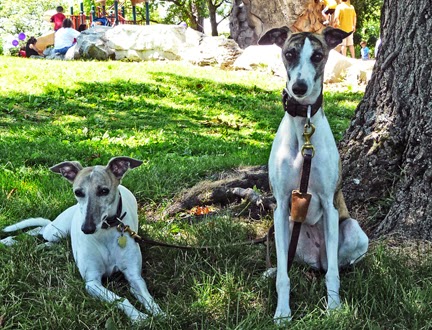
Come on, girls, smile for the camera
Saffron is my son’s 15-year-old whippet. She is without a doubt Garrett’s dog, but she and I have had a love affair since she was a tiny white ball in my lap. When Garrett graduated from college and left for the greater world, he insisted that we get another dog “so Dad won’t be lonely.”

Enter Greta, our almost-8-year-old other whippet. She, too, was once a tiny (brown) ball in my lap. Now she uses her doe-like Garbo eyes and completely un-Saffron smile to get me to share my chair with a much-less tiny her.

I’m a journalist, so my world revolves around communication. I’m pretty good at communicating with humans, but talent I admire most is communicating with other species. Dogs have their own grammar, their own vocabulary and their own favorite expressions.

Once in a while, I do pretty good job talking dog. Usually, however, Saffron or Greta just stand there wagging and grinning – and I’m sure saying “Come on, biped friend, you can say it.”

In the other direction, however, there is no communication problem. I know instantly when either dog wants a Milk-bone, thinks I need a cuddle or wants to go out to pee. (Definition of “speed”: Whippet going out to pee and back at minus degrees.)

Which brings me back to that smile. I can see it, I can appreciate it, but I can’t explain it. I’ve tried over and over to take a smiling-dog photo, but my whippets put on their classic-beauty face whenever I pull out a camera.

Our Garbo-esque Greta
I’m not even sure that a dog smile is a physical quality. It is more of an apparition. Like the ghost of a long-departed friend. You want to believe in it so much that quite willing to see what isn’t there.

Saffron and Greta smile at me with blunt-force subtlety. It’s just a sparkle in the eye, a cock of the head and a tongue peeking through a half-opened mouth. But oh, do I know they are happy with me. And I reciprocate with my bowed human lips and those telltale lines under my eyes. Then I break into a petting frenzy, make silly sounds (“whose a good girl?) and trot off for another Milk-bone.

Dogs may have used their keen senses to hunt for primitive man or their fangs to protect him from hungry predators. But we long ago invented telescopic sights and strong fences that do the job without consuming a sackful of kibble.

No, it is neither nose nor fang that earns dogs a special place. It’s the smile. We can’t really define it, but we certainly know why our hounds have it.

Dogs make us happy. 
- Clyde

Thursday, January 22, 2015

Back to school again. And again. And again.

By now, I should be used to the first day of school. I have, after all, had 60 of them.

There are few events in life that so mix anticipation with trepidation as the first day of school. In elementary school, I hoped to see friends who summer parted from me, but then I worried that the multiplication tables had changed over the break.

In high school, I was relieved that I wouldn’t be dodging Mom and Dad’s long list of summer chores, but I knew that I was too geek and not enough cool to sit with “the” crowd at lunch.

The rotten trick of college is that you have at least two first days each year. And the more letters you stack behind your name, the more of those first days you face.

As an undergraduate, I sweated that I would somehow so screw up that the draft board would send me an invitation to Mekong Tech. On the other hand, parties were never so memorable as when I was just under the drinking age.

The draft was gone by the time I was a junior. All I had to worry about is whether I would learn enough to actually get a job. But I had a beautiful coed on my arm and could look forward to decades of marital bliss. (That’s one dream that came true).

A sane person would have stopped there – as I did for 17 years. Graduate school has a way of sneaking up to you, though. Doubly so if you put a decade between master’s and doctoral programs.

The first day of term in grad school is a blur. Sometimes you have so many research projects you don’t notice the end of one semester and the beginning of another. You know you are on break, however, when you are franticly scrambling for whatever someone will pay you to make a dent in that tuition bill.

Of course, it’s a crapshoot whether the classes you signed up for will be anything like the titles in the catalog. I signed up for a “cultural studies” seminar to learn about minority audiences. I took a seat next to the guy in a Mao hat to learn how traditional media folk were ruining the world. Traditional Mao-hatless folk like me.

Now I’m a professor who not only faces two first days each year, but dons a cap and gown for two graduations each year. I like the graduation – its harvest time in higher ed. And after each graduation I swear I’m going to update my syllabi right away and have a complete set of PowerPoints ready long before I would see the next wave of students.

Yea, right. I’m a journalist. Skirting the finality of a deadline is in my DNA. The Journalism School is amazingly full of busy professors the weekend before class starts.

But just like in elementary school and my many other first days of school, the stresses of starting over now are more than balanced by the joys that come with them. I love that I’m on the other side of the pressure cooker. While I’m scrambling to prepare assignments, I get to watch the wide-eyed new undergraduates, the mentally-already-graduated seniors and the overwhelmed grad students find their places. And I get to offer advice, assurance and consolation. Because I know:

Been there, done that -- 60 times.


No. 3 in a paired-theme series with my daughter at http://driedfigsandwoodenspools.blogspot.com/


Thursday, January 15, 2015

Sticks in the window

I never really thought I would see beauty in a winter-bared tree trunk. But I suppose it is really a matter of how you frame it.

I learned about forests in the Northwest, where the definition of “tree” is something very tall, very green and very determined to stay that way in the coldest of winters.

When I first saw Missouri in the spring, I was amazed by the lush green canopy that stretched over me like an organic tent. You don’t really walk through the forest in the Northwest – you thrash through the low fir and spruce limbs hopint you won’t get a handful of needles down your shirt. But Missouri is on the edge of the Great American Hardwood Forest – that leafy cathedral through which movie Indians crept silently and under which the village smithy stood.

Of course, the movies seldom have winter editions. Hardwoods are lush in the spring and then spectacular in the fall when they burst out into color – just before losing everything. By November, that great leafy cathedral has become a bunch of naked sticks.

But I have come to love those sticks. This time of the year, I frequently find myself staring out my window in Zen-like silence, just watching the sticks.

We have five huge windows that look out on the forest. Between me and the trees is a deck, a heated birdbath and a couple of feeders. And umpteen-dozen squirrels, as many woodpeckers, and troops of nuthatches, wrens, jays and finches who enjoy my largess. Plus the odd raccoon or woodchuck come just to torment my dog.

My wintry oaks and maples are not just figures in a still life. The are the cast of a full-fledged matinee feature.

The view of those “dead” sticks through my windows is an ever-changing passion play. I’m constantly amazed at how tree trunks so bare can shelter an ark-ful. In the Northwest, I could hear that birds were up there, but seldom saw more than a flash of feathers.

Here the lack of cover means neighbors of any species have little choice but to politely nod to each other. So I stand at my window and raise my coffee cup to the creature of the moment.

It’s a Midwest kind of thing. Not a bad one, at that.

No. 2 in a paired-theme series with my daughter at http://driedfigsandwoodenspools.blogspot.com/)


Thursday, January 08, 2015

I’m a congenital writer.

Some people write because their third-grade teacher threatened to send them back to kindergarten if they didn’t finish their essay. For others, like me, the taskmaster is deep in their brain. We don’t write when we have to, we just have to write.

Which makes my predicament worse. I have writer’s block. For the past few months, I’ve dawdled, surfed the Web and pretended I had more important things to do rather than channeled my thoughts through the keyboard.

Oh, I’ve churned out the necessary reports, comments to students and emails that go along with being a college professor. I’ve even spent days agonizing through a research paper that should have taken a few hours. But the cathartic release that congenital writers long for, wasn’t there.

I know writer’s block all to well. For 25 years, I made my living piping prose from my brain to my fingertips as a newspaper journ
alist. Writer’s block is common in newsrooms. You see it in the glazed eyes of the reporter who paces the office and refills his coffee cup before it is empty. It was so universal that we would commonly talk about it or even implore “I’m blocked!. Someone help me out here.”

When I was the editor, the someone was me. My prescription usually was assign an emotion-fueling feature story. The best story is told by the person who lives it. The young woman who honors her mother by volunteering in the cancer ward. The youth with a deep passion for skateboarding. The old vet still haunted by memories.

As a reporter, you only have to repackage those stories. The “lede” jumps out at you somewhere during the interview and you find yourself rushing back to the keyboard to let the words flow.

Dam broken. Writer’s block cured – for now.

My daughter, Gillian, is also a professional writer and also suffering from writer’s block. Neither of us has now has a kindly editor to throw us a feature-story bone. But when we talked about it at Christmas, we devised our own plan.

Each of us will write a weekly essay on the same topic and post it on this blog. We will be forced to write, block or not.

This week’s topic was as simple as it was effective. Writers writing about writer’s block.

I think it is working. So I can say this with guarded optimism:

More to come…
No. 1 in a paired-theme series with my daughter at http://driedfigsandwoodenspools.blogspot.com/)

Monday, July 21, 2014

Tired? I should have been

She: "You should have the tires checked before we start on our trip."

Me: "They look fine. I'm sure they'll be OK."

Tires (2,000 miles later): "Let's blow this place."

Me: "Deleted."

I really did think the tires on the car looked fine -- until the orange light in the shape of a tire started glowing on the Prius dashboard.  Then, as we pulled into the hotel parking lot in Kennewick, WA, a man walked over and said "You might want to look at that tire."

I did.  And as I watch, it got flatter.
Tire-some shopping

The upshot is that a nice guy from AAA met us Sunday morning to change the tire -- partly because I found out the lug wrench in the trunk did not fit the nuts on the wheels.  Then we went shopping for black rings at a nearby Firestone dealer that was thankfully open. Many hundred dollars later (an a walk through the nearby mall while waiting), we were back on the road.

Cecile was very nice.  She didn't say "I told you so."  She didn't have to. Her look was very eloquent.

Hood ahead
But by afternoon, we had crossed into Oregon. The sun was out and so was Mt. Hood -- the majestic peak that sometimes peeks from the clouds around Portland.

The sentinel mountains in the Northwest never fail to impress me. The stand not clumped in ranges, but on their own like majestic beings.  I grew up seeing Mt. Shasta and Mt. Lassen on my horizons. Mt. Hood and Mt. Rainier are often hidden in clouds, but anchor Oregon and Washington -- and Oregonians and Washingtonians.


For an Oregon expatriate, the sight of Hood over my hood meant I was on the path back to where attendants always pump your gas, not recycling is a mortal sin and Ducks don't just quack, they play football.  I'm feeling pretty Green.


Sunday, July 20, 2014

Renewing the Idaho connection

How much friendship can you pack into an afternoon? Years. Years and years.

After spending the night in Missoula, MT, we called ahead to see if Nils and Mary Rosdahl would be home as we passed through Coeur d'Alene, Idaho.
Nils and Mary


Nils and I worked together on the Coeur d'Alene Press back in the 1980s.  He was the lifestyle and business editor while I was the news editor -- and later managing editor. Nils left the Press to teach at North Idaho College long before I veered off to academia. He and Mary stayed in Coeur d'Alene when we headed off to Texas, Oregon and eventually Missouri.

But today, all the trips and the years out of touch disappeared and we lost ourselves in our many, many shared memories. Kids, grandkids, trips, pleasures and tribulations -- we went through them all. We also saw the hobby Nils took up in retirement.  He collects old type once used for printing and makes fabulous art with it.

Nils and Mary also took us on a tour of our old hometown. It's nearly doubled in population in the 26 years since we lived there.  More importantly, it has quadrupled in popularity among the tourists who flock there to enjoy the clean air and spectacular Coeur d'Alene Lake.

But behind all the new buildings, the Cd'A we remembered was still there. Including our old house on Foster Avenue. The house, like most everything in town, had been spruced up considerably to reflect the rising property values.  When I last stopped in Coeur d'Alene 14 years ago, our old house was for sale.  The flier offered it for exactly $100,000 more than we sold it for.

Our beautiful old house
The town has a spectacular new library complex and what was a big soccer field is now one of the nicest playgrounds I have ever seen. Nils made a typeface table for the library -- spelling out words related to reading across its top.

As we left town, Cecile looked out to where the city faded into the beautiful lake.  "We could move back here and drop right back in, couldn't we?"

Maybe in July. But Idaho is another place in February. I prefer to keep the good memories and conveniently forget the snow and ice.


Saturday, July 19, 2014

History writ big on a hillside

In 1966 I became a temporary Virginian when my father moved the family east for three months so he could attend a National Guard NCO school near Washington, D.C. On weekends, we would tour the myriad museums historical sites in the area -- especially Civil War battlefields.

My dad loved seeing the ground over which great military minds plotted strategy. One of my favorite memories is watching him standing in his khaki uniform, gazing from the Cemetery Ridge at Gettysburg, where Union artillery snuffed out Pickett's Charge.

"The fool. The damned fool," he almost shouted, pointing to the large treeless field over which Maj. Gen. George Pickett marched a whole brigade of Confederates to their deaths. The Old Soldier could see the whole  battle before him and the absurdity of the charge.

Not me.  I could see a big field of grass and some old cannons with National Park Service signs. Battlefields look an awful lot like farms to me. Except for the one we visited today: Little Big Horn.

Better known as "Custer's Last Stand," this National Monument is where Sioux and Cheyenne arrows did to Lt. Col. George Custer what the Union canons did to Pickett.

Last Stand monument, from the Indian Warrior monumen
Custer was also on Dad's list as another "damned fool." Custer wouldn't wait for reinforcements, left his big guns in camp and told the supply train with ammunition to wait behind the hills.

The Montana battlefield itself makes it quite clear why the Old Soldier disliked Custer. To my knowledge, this is the only battlefield that marks the place where each soldier fell.

There is a big cluster of white markers on a small hill where Custer and a small band of soldiers made their famous last stand against a tidal wave of warriors. But the heart-rending story of futility is written in the dozens of other markers scattered across the scrubby hillsides.

When my son and I stopped here on a 2001 trip, the battlefield held Garrett in awe.  That's saying something: Garrett was 16. You go try to impress a 16-year-old guy (Hot cars and pretty girls excepted).

Scattered white stones mark where 7th Cavalry troopers fell retreating up the hillside

But the analytical mind that in time led Garrett to be a successful engineer clicked into action.  I saw in his eyes that same vision of the past that my dad glimpsed that day at Gettysburg.

Today it was Cecile's turn to be introduced to the Battle of the Little Big Horn.  The sagebrush was higher this time and the markers of the fallen harder to see.  Still, you could easily sense the desperation of the few hundred 7th Cavalry troopers pushed by an impatient Custer toward thousands of Indians. Indians he was trying to force onto a reservation. You can see where soldiers were picked off one by one as they retreated up a hill, or where four or five troopers were surrounded and slaughtered.

It's a stunning lesson that the land tells better than any movie or book.

The markers of the dead today look down from Last Stand hill
(Side note: I was surprised to find that the Sioux, like the whites, were interlopers at the Little Big Horn.  The battlefield is today on a Crow reservation and the Crow scouts fought with Custer.  A ranger explained that the Sioux was a big, aggressive tribe that had decided to push the Crow off of their hunting grounds. It's hard to find good guys in war.)


Friday, July 18, 2014

Those big guys on the mountain

I'm in awe of sculptors. How they can crack open a rock to release art is beyond my comprehension.  When I crack open a rock, it just cracks.

Michelangelo is no doubt the master, creating masterpieces so detailed and realistic they look as if they could walk off their pedestal.

But it is one thing to release David from a block of marble. It's quite another to release four humongous presidents from the side of a mountain.

The mountain and the presidents
We visited Mt. Rushmore today.  It was a return for me, bringing back good memories of the time Garrett, our whippet Saffron and I drove across country to start our new life in Missouri.

Garrett was in high school and, as is the requirement of all young men, not enthralled with his father's ideas.  But he agreed that Mt. Rushmore was worth the two-hour detour from our trip.

500mm - Photographic nosiness
Cecile was still working, so missed that edition of the Roadtrip. And she missed Mt. Rushmore.

Since Garrett and I were there, the National Park Service has expanded the parking and visitor areas. But the main attraction is still the four big guys on the hill.

Cecile was duly impressed, especially when she saw how high on the mountain the faces were.  From the pictures in books, the presidents might have been carved from a big rock bluff closer to ground level.  For my part, I got a bit carried away with a 500 mm lens and ended up looking up presidential nostrils.

It is beyond me how Gutzon Borglum looked at a mountain and saw Washington, Jefferson, Teddy Roosevelt and Lincoln.  And then how he marshaled a crew of miners and loggers to blast bits of the mountain off with dynamite until they could see his vision.
Big George

Like the Washington Monument, the Lincoln Monument and the Golden Gate Bridge, Mt. Rushmore is one of those icons of nationhood that every American should see at least once.

But you still can't expect me to look at a rock and see the next great piece. I'll leave that to the masters.

Yes, let's take a Rushmore selfie!
The gala entrance to the mountain overlook


The path to greatness is well-trod at Rushmore

Thursday, July 17, 2014

What's a road trip without waterfalls, buffalo and rattlesnakes?

The beauty of Florence overwhelms you like a bouquet from heaven just as its rich history soaks you to your soul. But even Michelangelo would have been impressed by the sights we enjoyed on the road today.

The sky was shockingly blue with a simple counterpoint of fluffy white clouds.  Below, the green grass rolled to the horizon.  This is the great American Prairie.

Our cross-country travels took us today from Sioux Falls on the eastern edge of South Dakota to Rapid City on the other side.  Between were sights, people and creatures that challenged my mind and soothed my soul.

Sioux Falls
After a quick breakfast at our Sioux Falls hotel, we headed out to see the cataracts that give the city its name. They are not tall, but are impressive.  The torrent has polished the bedrock in and around the falls to the smooth finish of sculpture. The ruins of a giant mill line a shore now swathed with well-groomed park lawn (upon which scamper cute little critters with a name longer than their bodies -- thirteen-lined ground squirrels).

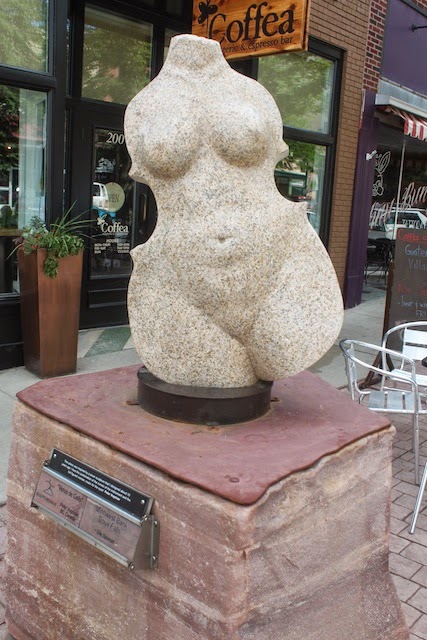
We then went downtown to walk the Sioux Falls arts district.  Each May, the city picks artists whose sculptures grace the sidewalks for a year.  It's a spectacular way to give a city character.

Venus de Cello
The cornfields gave way to hayfields and eventually to rangeland as we headed west on I-90, listening to "The River of Doubt," the tale of Theodore Roosevelt's adventures in the Amazon. It was a nice contrast between Teddy's nearly-naked jungle Indians to the stately Lakota Sioux, whose museum we visited in Chamberlain.

The land grew wilder as we drove, especially when we turned off to the Badlands National Park. This moonscape of volcanic ash and fossil-laden rock was sculpted by wind and water. Beyond the landscape and the incredible population of wildlife at roadside, the park gave us another pleasant surprise.  We qualified for a National Park Service lifetime senior citizens pass. Damn.  I really am old. But give me the discounts anyway.


The park's rocky spires are unbelievable in any light.  But as the sun started to set and the shadows grew long, they were spectacular.

And the wildlife. Bison, big horn sheep, hundreds of prairie dogs, rabbits... and rattlesnakes.  We paid minimal attention to the warning signs until hearing an urgent rattle in the grass and watching a snake slither under the boardwalk trail. That's the "wild" part of life.
A big horn lamb, a rabbit, a 13-lined ground squirrel, a baby bison, a prairie dog and mamma bighorn

Wednesday, July 16, 2014

On the road again

Cecile is determined to make the most of her sabbatical, and I'm right there cheering her on. Or more accurately, traveling on.

Florence is now a fond, fond memory that has given way to an epic cross-country road trip.  We are on our way from Columbia, MO, to Portland, OR, to visit our daughter, our son-in-law and our genetically superior grandchildren. Today we finished the first 500 of our 2,000-mile road trip.

Happy Gillis makes happy diners
The road to Oregon is paved with food.  At least that is part of our strategy.  We have vowed to refrain from any chain eatery.  Smart phones make our goal a bit more obtainable.  We have a Diners, Drive-ins and Dives app, Yelp and the power of Google.

That first app is how we found Happy Gillis Cafe and Hangout in the Columbus Park area of Kansas City.  Columbus Park was once infamous as a haven for the Show-Me branch of the Mafia. The mob is gone, but the food only got better.

Happy Gillis is a former corner store turned artsy cafe.  Guy Fieri loved it with good reason. The sandwich menu was astonishing.  Cecile had a bacon and date melt while I had a pork comfit sandwich. Find that at McDonald's.

We rolled north on I-29.  A sign at Nebraska City caught our eye as a logical place to fulfill our other vow. You can't cross America just on a set of tires.  We promised each other to walk at least two miles each day of our trip.

We got a mile in earlier walking the quaint streets of Columbus Park.  But new we wanted to follow the footsteps of Lewis and Clark.

Explorers' selfie on the bluff
The Lewis and Clark Missouri River Visitors Center sits atop a bluff overlooking a stretch of the Missouri River that challenged the Corps of Discovery in 1802. There are similar centers along the route from St. Louis to Astoria. We started our admiration of the explorers in reverse order while we lived in Oregon. It's now nice to read their log entries when they were still pumped up with excitement. By Clatsop, they were tired and cranky.

Giant prairie dog
The upshot is that we knew most of the historical facts, but loved the wildlife displays. Can you imagine what it was like to first spot a buffalo? Or to catch the first cutthroat trout on record? My friend Jim Bird once said that the Lewis and Clark expedition was every bit as daring, every bit as great a scientific challenge and every bit as impossible as the first moon mission. And there are no grizzly bears on the moon.

Petrow's in Omaha
The center's river overlooks and trails gave us another two miles of wandering before we set off again -- in search of food.

All the DDandD spots in Omaha seem to close after lunch, but Yelp took us to Petrow's Restaurant.  It has fed countless Nebraskans since the early 50's, but proudly brags that "Over two billionaires served." Both Warren Buffet and Bill Gates have sampled the simple diner fare.  I'm not sure if there really is a third billionaire to warrant the "over." The fried pork tenderloin was good, but not great.  Great waited for the sour cream raisin pie.

And now we are in South Dakota's Sioux Falls for the night.  I was here for a conference once and was enjoyably surprised to find it beautiful art haven that also boasts a butterfly zoo.  Tomorrow morning we will drive down the the old downtown art's district, where sculptors are invited to place their works on street corners for a year of public admiration (and maybe a sale).

Then, like Lewis and Clark, we head west.  On to Mt. Rushmore and the hills where Custer learned what happens when you really tick off the Sioux.


Sunday, June 29, 2014

An alternate ending

The last few days of a trip are always a blur, as you try to see everything you might have missed, force all the souvenirs into the suitcases and gather last-minute memories.

Ours was all that, overlaid with a sad difference. After we flew from Florence to Paris to Cincinnati to  St. Louis, I left Cecile at the airport for another flight to Chicago and on to Sacramento so I could be with my brother at his wife's funeral.

Mark was once the blond; I was the brunette.  Now we share gray heads and lifetimes of memories.

Watching memories cut short by a death is hell. I can hug Mark, I can tell him I'm sorry and I can just be there in love.  But I can't really share the pain of losing someone who was is life for 35 years.

Ja'nice Bentley took her own life June 8 by driving to a beautiful mountain cabin and swallowing pain pills. She was depressed, as so many of us are at times. But I can't explain to Mark why on that day she chose to leave both the depression and all the stored-up good times. No one can.

The funeral was nice -- an oxymoron if there ever was one. A large, supportive crowd of neighbors, friends and coworkers from in and around Ione, CA, came to pay tribute to Ja'nice and share their love for my brother. Each family member was given a rose and we all placed them in a vase as a final present to her. The two preachers said words of comfort, we all exchanged hugs and then went back to the house for food and more shared memories.

That there were so many hearts opened to Mark took a burden from me. I know that he will survive, supported by the whole community of people I saw stand at his side.

And tomorrow I'll go home to the one who is always with me, and with whom I'll always be. And with a little rest, I'll refresh the good memories Cecile and I made in Florence and perhaps write a bit more about our Italian venture.

For what I learned so very well during this joyous month in ancient Italy and sad fews days in northern California is that there is no end. Good, bad and in between, life just is.


Saturday, June 28, 2014

Final Flurry in Florence

Wrapping up a month of exquisite experiences is difficult in the best of circumstances.  But when you've basked in the Tuscan sun in Florence through June, the best you can do is dash from favorite place to favorite place to vainly hope you have taken it all in.

I visited with the faculty of the Florence University of the Arts (their journalism school) while Cecile took a lesson in gourmet Italian cooking. We took panoramic photos of our neighborhood streets and said farewell to Dafi Krief, wonderful landlady. One more walk to the Duomo and of course, several stops for gelato.

There was a spectacular sunset over the Ponte Vechio, then it was gone. It was back to our "real" life after what seemed only a moment of magic.

Thursday, June 26, 2014

I like bike

Bicycles, bicycles -- bikes in every flavor. Florentines love their bicycles - la bicicletta. For good reason. It is not only cheaper to peddle, but in some parts of the city, faster than driving a car.

The classic, utilitarian single-speed
I snapped photos of bicycles wherever I went in Florence. It was a delight, as something different was always rolling around the corner. Every imaginable variation on the standard two-wheeler was there. Some were as beautiful as a Ferrari, some were ready for the scrap yard and most were in between.

Like all bikes in Europe, they were equipped with lights and bells. That gave a somewhat musical touch to walking the narrow streets. Bicycles have the right-of-way, so you had to be ready to jump aside when you heard the "ching-ching" of a cyclist coming up from behind.

Some observations from snooping for spokes:

-- Most of the bikes I saw were single speed.  Many others used hub gears. But the terrain was flat with little need of low gears.

-- Neither age nor gender discourages Italians from cycling. It was not uncommon to see a grandmother on a bicycle (or a motor scooter, for that matter) and quite often you would see a mom with toddlers in both front and back child seat.
Flower vendor's trike

-- I could easily tell at a distance if the cyclist was an American.  We hunch over, leaning on the handlebars of the bike.  Italians ride upright with their hands lightly on the bars and the weight on the seat.

-- Electric-assist bikes were everywhere.  I was impressed by the variety of brands and the variety of people using them. I have a Chinese-made electric, but it is much noisier and less sleek than those I saw in Florence

Frisbee electric-assist


-- Florentines often park their bikes against the curb, using a pedal as the stand.

-- Bicycles are parked overnight at community racks. To deter theft, Florentine cyclists use chains that could shackle King Kong.

-- Almost all Florentine bicycles have at least one basket or similar carrier. This is not a city of Spandex-clad racers.  Bicycles here fill the niche of family cars and pickups in the U.S.

My full collection of bicycle photos from Florence is in a Flickr slideshow.


Wednesday, June 25, 2014

Bombs bursting and bursting and bursting in air

I think Florence may have spoiled my Fourth of July.

The Mayor's Parade
Tuesday was the big annual holiday in Florence -- the Feast of St. John the Baptist.  John is the patron saint of Florence and each June 24, the city toasts him. I watched the Renaissance parade, which was much the same as that I saw earlier for the Calcio Storico Fiorento - the "historic football" brawl.  The finals of the four-team match was supposed to be Tuesday, but the new mayor of Florence ruled that the game was more fist-fight than football, so cancelled it.
Got to get a selfie once in a while

The good mayor did, however, walk in a parade with and armful of candles, which he gave to the cardinal of Florence has mayors have for generations June 24.

But the big party was that night.  The city puts on a fireworks show to end all fireworks shows.

Fireworks next to San Mineato al Monte (right)
It is not enough that the show features one of the most beautiful settings imaginable.  The fireworks are lit at the Piazzale San Michelangelo next to the 11th century San Mineato al Monte Basilica. Most people watch along the banks or from the bridges of the River Arno.

Then there is the quality of the fireworks.  I've never seen so many colors, such unusual arrays nor the volume of fireworks blasting into the Florence air.

But the topper is the length of the show.  It went on for a good hour, during which perhaps a thousand or more rockets burst their red, green, gold, blue and even orange glare.

Taking photos of fireworks usually stumps me.  I got at least one passable shot with the camera.  But I have a lot more "mind photos" stored away in my organic hard drive.

There are monsters in the Arno

Thousands of people walk over the Ponte alle Grazie in Florence, never noticing the monsters below their feet.

Not long after we arrived, we were looking over the bridge and were astounded at what we saw in the murky water.  There were the expected large carp swimming through the weeds, but then this huge thing started undulating along the bottom like a massive snake.

Ponte alle Grazie
Actually, it looked like what I always imagined a sea serpent looked like. Very long -- six or eight feet.  Large head, smooth skin and a tail that came to a point rather than splayed like a normal fish.

In moments there were four or five of the beasts swimming beneath us.  It was too dark and I did not have a long lens with me, so I couldn't get a photo.

But Cecile and I watched in awe.

I've tried almost every day since then, but couldn't get a decent photo.  I would see snatches of the fish, but not like that first time.

I did look them up, however, and found they are truly what the Animal Planet show calls "river monsters."

The Arno is home to the Wels catfish, Silurus glandis. It's a native of Eastern Europe that is now in several Western Europe rivers.

Jeremy Wade of River Monsters
Big is an inadequate word for a freshwater fish of this size.  They will grow to 12 feet or more and have weighed in at nearly 400 pounds, though most caught this day are in the five-to-six foot range. They don't swim like a normal fish, either, but slither through the water like a snake.

They are not particularly friendly, either.  It takes a lot of protein to keep a critter that big healthy, so they gulp down copious amounts of fish, frogs and worms.  And also ducks, pigeons, mice and anything else that ventures near their cavernous mouth. Jermy Wade, host of River Monsters, nipped on the leg as he tried to release a Wels he had just caught.

I'll try at least one more time to get a photo of the mighty Wels, but I have little hope.  We were lucky to see them in even dim daylight, as they prefer to feed at night.

But I'm not stick a toe in the Arno, even at noon.


Monday, June 23, 2014

Days of discovery

Some of the most satisfying discoveries are those you make without trying.

We are down to our last week in Florence and have toured all of the key tourist magnets. Now what we do is wander the city and duck into interesting looking places. Along the way, you never know what you will find:
Antarctic map

Genoa's Christopher Columbus may have made it to the New World first, but Florence home-town boy Amerigo Vespucci got his name on the continents. Why? Florentines make maps.  Really great maps.

The map room in the Palazzo Vecchio is filled wall-to-wall with stunning maps. Less than 70 years after Columbus sailed the ocean blue, Florentine cartographers mapped the Gulf of Mexico so well Texans today can locate their spreads. But I was surprised to see maps of the arctic north of Greenland. Then I was floored by a set of maps not only showing the Straits of Magellan at the tip of South America, but interior details of Antarctica.  It's one thing to sail past the icebergs, but quite another to plot the lines drainage from the interior glaciers.

The other Florentine that deserves homage is Leonardo da Vinci. But the public museums were pretty thin on Leo's work,  leaving the curious to two private "museums."

We avoided this until now because our previous experience with cheesy road-side private museums has been pretty disappointing. But our trip to Le macchine di Leonardo da Vinci was both fun and enlightening.

Masterpieces of exploration
Leonardo (di Vinci was his birthplace, not his name) was famous as a painter, but known in his day as a fabulous engineer.  This museum is packed with wooden models based on his staggering set of notebooks. Some of his notes were just reminders to pick up the laundry or shopping lists, but along the way he designed a tank, came up with an automated pipe drilling machine and made an exercise machine that would look right in most gyms.  Being a little boy at heart, I liked the fact that the museum let you play with the models. While I was on the exercise machine, Cecile read in the notecards that Leonardo didn't really pump sandbags.  He used the machine to test muscle response to different weights and leverages.

The other great discovery linked Columbia,  MO, to Michelangelo via Jackson Pollock.

Pollock sketch
A special exhibition at the Palazzo Vecchio displays some of American painter Jackson Pollock's early work. All were sketches based on the famous artwork of Michelangelo on the other masters. An interactive display let Pollock's sketches morph into the Sistine Chapel with eery accuracy.

But the surprise is that Pollock made the sketches at the insistence of his art teacher -- Missouri's own Thomas Hart Benton.  The exhibition literature said the Benton insisted that Pollock learn the details of Renaissance paintings to learn the fundamentals of composition and design.

Me and my bud Antonio
Last night at dinner I made an fun and calorie-free discovery at dinner.  It was the opening of a new restaurant on our block and the owner was excitedly pointing out his relatives and friends at tables.  One was Antonio Castiglia, one of the field captains for the San Giovanni Greens in that crazy Florence sport, Calcio Storico Fiorentino. Here was a graying guy not much younger than me but buff as an Olympian.  His tattoos alone would give an opponent pause.

I couldn't help going over and introducing myself as one who had watched the game. He was a bit confused until I showed him my green University of Oregon ring.  Then I was one of the family.  He gave me a worn keyring from his pocket and his daughter or maybe daughter-in-law translated that the would try to send me a T-shirt.

(When we got home, we found that the new mayor of Florence had
cancelled the final in the Calcio tournament because the teams were refusing to play by the rules. Castiglia's Greens took much of the blame when they lost their semi-final by default because a fouled-out player simply refused to leave the field.)

There are more discoveries every day -- a great gelato, "the" gift for relatives, a hidden view of the Duomo. But the best recurring discovery is of the grace, courtesy and gentle humor of the Florentines.