Tuesday, June 17, 2014

Shop till you drop or eat till you drop?


This is where folks come for clothing bargains
We celebrated our anniversary by taking look at the non-tourist side of Florence, then experiencing the culinary skill that tourists and natives alike cherish.

Advertise, advertise, advertise
Armed with our shopping bags and cameras, we jumped on a bus to Florence's central railway station, where we took the electric tram to Le Cascine park. Every Tuesday morning, the huge park becomes a huge market. This is not one of those cutesy souvenir emporiums, but the real market at which real Florentines shop. The normal fresh produce of a farmers market is there, but so is everything from hardware to pets to cheese to undies.  Clothing, in fact, dominates the market. Much of it is cheap every-day stuff, but here and there are racks that appeal to the fashion maven.

Checking the India (guinea) pigs
Cecile bought a very nice linen blouse and we got a "deal" on a big block of Sardinian sheep cheese and two equally big blocks of nut-filled nougat.  We really wanted just a thin slice of each, but language and appetite got in the way.

After we finished shopping, we realized that we could walk a short-cut along the river in the same time it would take us to hope the tram and bus. "Short-cut" in Florence is really an oxymoron. The distance between cathedral towers is either longer than you thought or mined with wonderful little side streets that you just have to check out.

The upshot is that it was a nice walk, but we returned home pooped. But we had time to rest up for our anniversary dinner out. Our reservations were for 8 p.m., but that was still early by Italian standards. The restaurants here go in high gear from about 9 p.m. to midnight.
After 42 years, we are at the garden gate 

Our landlady, Dafi, told us about a great restaurant within walking distance -- but on the condition we would not tell others of our find. So you don't know about Beppe Ristorante down the hill from Piazza Michelangelo

Oh, but if you did... Traditionally in Italy, you have three courses plus desert. The antipasto is what the British call "starters," and can range from salami and cheese to soup to the chef's latest creation. The primo is the course best loved in Italy -- the pasta, polenta, soup or rice. Then there is the secundo, or main course. A favorite here is Florentine steak -- a T-bone that looks like it comes from an elephant. But you can also choose seafood (frutos do mar) or culinary creations of veal, rabbit, beef or vegetables.  You can also get a vegetable course (contormo) if you don't care about leaving room for a sweet ending (dolce).

And this is at 10 or 11 at night.

We made it through the antipasto -- a 2-foot cutting board piled with cheeses, salami, proscuitto, and a large bowl of pâté. I could (should) have stopped there. But Cecile had a risotto while I had a rabbit pasta. And wine -- the size of bottle of which was as deceptive as a Florentine short-cut.

But no steak. I simply couldn't make it to a secundo. But dolce? Si! I had a ball of lemon gelato wrapped around a frozen ball of limoncello. A cannolli for Cecile. A very big and very rich cannolli.

And then, about 11 p.m., we waddled home. And at 2 a.m., I was looking at the ceiling wondering if my belly would go down before dawn.  I don't know how the Italians do it.

But ... I'm game to do it again.

Andrea sings while Florence shines for Cecile

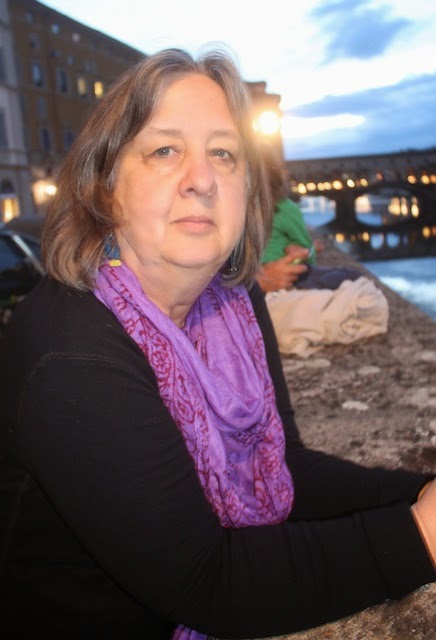
Today is our anniversary, so last night I had Andrea Bocelli sing to Cecile from the moonlit banks of the Arno River in Florence.

Well, he didn't sing Puccini's Gianni Schicchi just for Cecile, but she didn't mind sharing with the several thousand people who gathered near the river to see the re-lighting of the famous Ponte Vecchio.

Sunset lighting, the old way
The Ponte Vecchio (the "old bridge") is the span that the Medici family used to get from their offices in the heart of Florence to their Pitti Palace across the river ("Oltrarno"). While a crossing has been there since Roman times, the present bridge has been there since 1345. It was the only bridge in Florence not blown up by the fleeing Germans in World War II.
Fireworks and new light bulbs for the Ponte Vecchio

And that's a very good thing, as we were left with a beautiful piece of history. Back in the 14th century, the roadways on bridges commonly shared space with shops and houses.  The Ponte Vecchio was lined with butcher shops so they easily cleaned up by dumping their trimmings in the river.

When the Medici began making the trek to their newly-acquired palace, the stink of a pre-refrigeration meat market just wouldn't do.  So they kicked out the butchers and installed goldsmiths and jewelers. They also took over the top floors to give themselves a private passageway home.

Still festooned with windows, roof and telltale jewelers, the bridge today is a major photo op and shopping magnet for tourists. When the sun sets over it, cameras and tripods sprout like mushrooms on the upstream Ponte alle Grazie. After dark, the bridge lighting was better than it was with 14th century torches. At least a little better.

The floating lady floats, the guy runs on a treadmill
This week is the 60th anniversary of the Florence Fashion Center, so the Italian fashion designer Stefano Ricci celebrated by funding a re-do of the bridge lighting system with "green" and bright LED lights.

There is some irony in having a blind tenor throw the switch for the lights, but it didn't dampen the enthusiasm of the crowd nor our enjoyment of his singing in the cool Italian evening.

The build-up was a little strange, though. A French art troupe put on an "aquatic spectacle" that was as confusing as a French art movie. It was a parade in which the floats floated -- way out in the middle of the dark river where you couldn't really see them. I liked the waterborne old Fiat 500 and the 20-foot lady in white wig and elegance -- propelled by a man on a treadmill. Most of the others were either too vague in design or too far out of sight to appreciate them.
Amore mia, Cecile

The troupe, Illiotopie, seemed to have overlooked both perspective and timing.  Their worse faux pas was motoring/paddling the floats back upstream to the starting point past the entire curious crowd -- with all of their lights turned off. Why in the world they would want to sneak past several thousand people who didn't get a good look the first time, I'll never know.

But I can't complain. I spent an evening under the full moon on the river in historic Florence as Andrea Bocelli serenaded the girl of my dreams for the past 42 years.

Happy anniversary, my darling.


Monday, June 16, 2014

They call it football, but some things just doesn't translate

To the SEC gridiron jocks who think they are tough: You are a bunch of wimps compared to the church boys from Florence.
The parade and entertainment before the game

Sunday we watched a sport that puts WWF wrestling, arena football and demolition derby in the "fit for preschoolers" category. Calcio Storico Fiorentino. Each year in Florence, just before the June 24 St. John the Baptist holiday, the four neighborhoods with cathedrals get together for no-holds-barred "football" in the piazza of the Santa Croce basilica. Saturday, the Whites from Santo Spirito beat the Blues from Santa Croce. Tonight we had tickets in the Green section, rooting for San Giovanni Baptistery against the Reds of Santa Maria Novella.

Big, mean Green machine
The "sport" that dates back at least to the 1400s (or maybe to Roman times) is more a mini war than a game. But it is so engrained in Florentine culture that in 1530, they sent a "screw you" message to the attacking Holy Roman Empire and played the game instead of going to battle. Florence proudly continues both that sentiment and the game.

Enthusiastic Green fans
That ancient background lends itself to pageantry, something the Florentines are very good at. Period-dressed musketeers, crossbow archers, horsemen, nobles and others Galileo would know march into Piazza deal Signoria and then on to Piazza Santa Croce to the sound of massed drums and bugles. A highpoint for me was the company of flag bearers who toss their flags high into the air, then catch them with aplomb. They even toss them in wide arcs to each other -- and no one missed.
Simon said, in English

We watched San Giovanni (the Greens) lose to Santa Maria Novella (the Reds), who now will go to the finals against Santo Spirito (the Whites) who beat Santa Croce (the Blues) the night before. Simon, an English-speaking student sitting next to us, explained the rules. Which really can't be explained unless you are Florentine. Basically, no murder. If you kick someone in the head -- while they are down -- or rabbit punch from the back, you are expelled.

The basic strategy is to send out a line of big, tough, tattooed guys for the first 20 minutes and try to knock out the strongest competitors. Then the teams run the round ball while trying to not-quite kill each other. Put the ball in a stadium-wide net and you get a point. Go over and the other team gets half a point.

It's just a game. Or a brawl, or maybe a war
We got into the game fever and jumped up to shout "Picchia Verde, Picchia Verde Eh, Eh!" while shaking our fists at the Reds. It means something like "Go, Greens and beat the crap out of the other guys but don't let the refs see you and toss you out."Keith Greenwood, a fellow Mizzou prof here teaching arts journalism to a band of our students, was with us in the stands (and later for vino and good food). He is a photo journalism professor, so we got to talk shop (his camera is much cooler than mine, but I also had a 3-D camera in my bag.)

Keith Greenwood
You only had to look at the end of the game to see how seriously Florence's neighborhood tough guys treat the game. A Green player was ejected for kicking a Red guy while he was down. But instead of glumly shuffling to the sidelines, he refused to leave and played on. This caused a referee to suspend the game and give it to the Reds by default. And then, of course, another referee tackled the first referee.
We were in the stands

The Greens were upset for a few minutes, but then reverted back to the 1530 attitude. The all walked toward the Green fan section pumping their arms and saying something that needed no translation:

"Screw it."

(There was so much to see that I created a special Flickr album of photos of the game.)

Saturday, June 14, 2014

Touring Tuscany: Siena, San Gimignano and Pisa

How do you pack nearly 9,000 square miles of history and art into a single day? With a big bus and a couple of very animated guides.

Not me. But what I was afraid of.
Friday we signed on for a bus tour of Tuscany with Walkabout Tours, a small tour company that has carved a niche with very entertaining people and out-of-the-box ideas.  One of their other tours assigns people to tiny pre-1970s Fiat 500s. The guide drives in front and the tourists zip through Florence in line behind them, ala The Italian Job (with cuter cars).

We have been avoiding bus tours here and elsewhere for years.  We had a vision of a mobile geriatric ward of ornery old folk.  OK, so I'm an ornery old fart now -- but I didn't want to live the stereotype.

As it turned out, the tour drew people of all ages, from kids to a few older than us. Lots of 50-something couples. And an incredible on-bus guide, Elisa. (If we didn't like her, she said to write about her as "Christine."). Elisa was Florentine, but spent years in London with her Spanish husband (I got lost there, too). She managed to weave textbook history into a multi-cultural patter that kept smiles on every face. During the last few miles of the trip, she walked up the aisle to talk to each passenger about the trip.

The tour went from Florence to Siena, then to a winery and farm near San Gimignano for lunch, a pop over to San Gimignano and then on to Pisa.

Siena is often considered the most beautiful town in Italy. Especially by the Sienese -- and never by the Florentines. Florence was the capital of the wool trade and then went into high finance.  Sienna skipped the sheep and went straight to banking. Allegedly, they took their money-changing skills to London, where they asked passing Brits to come over to their banco -- workbench  or counter.

Olivia explains Sienna
That's one of the many stories told with eye-rolling gusto by Olivia, our Siena guide. I could be happy skipping the antiquities and just watching Olivia for the day. Her hands pumped more air than an aerobics instructor's.

Sienna's cathedral and inside its dome.
Siena won the major military battle of the medieval age, but lost the commercial war in the 19th century. Between those dates they put together a city that makes even major art museums look second class. The order of the Siena-Florence wars gets some credit. Siena had hundreds of years as the wealthy victor in which it could lavish its riches on the art world.  When it finally lost, there were no bombs or pillaging -- just deficits in those work benches.  That left the opportunity to recoup by inviting tourists and their euros into town.

The cathedral
Siena is picture perfect. Not just in the postcard way, but as if a team of designers who would later work for Architectural Digest had control of the town. Every bit of the artwork seems to fit exactly with every other bit. Stepping inside of the cathedral is like watching a great scene in a Francis Ford Coppola film.  All the lines converge perfectly and every color merely accents all the other colors. Look up inside the dome and you would swear you see hundreds of carved and gilded panels -- yet it is really a tasteful illusion,  painted with masterful 3-D perspective.

Onward! Better yet, onward to lunch.

We wound through the Tuscan hillsides to an organic farm/winery within sight of the San Gimignano towers.  The old town once had more than 70 tall towers -- a sign of wealth in medieval days.  Even with the 14 left, its skyline lives up the its nickname of "The Wall Street of Tuscany." We had a hillside view of that skyline as we ate fine pasta and cured meats and drank wine.  Lots of wine. A San Gimignano-local white, a chianti, and Tuscan red and finally sweet Vin Santo into which we dipped our cantuccini cookies.
San Gimignano.  Cecile has become a wiz at panoramic photos with her iPhone.  I just have to stand still and wait.
A very happy crowd boarded the bus for the short ride to San Gimignano.  Its tiny by tourist-town standards (pop. 7,000) and all contained within massive stone walls.  It's pretty, but I think all of those 7,000 people are in the shops and stalls along the medieval lanes, selling ceramics, leather, artwork and trinkets for every budget. We spent more time than usual inside those shops because a sudden thunderstorm dumped a deluge on all the folks with expensive cameras.

Finally, a longer trip to Pisa, with scenery unremarkable enough the we could take naps without guilt.

A little to the right.  No left...
Pisa is a gritty manufacturing and maritime city with white marble heart that is instantly recognizable in the western world.  It's tourist central.  Your bus parks on the outskirts and you board a German-made Tschu-Tschu "train" that carts you through the streets to the epicenter of leaning monument land.

I did it.  And yes, I'm proud...
Elisa reassured us that it was not only OK, but expected that we each take a "cheesy" photo of ourselves holding up the tower.  She even gave us photo hints. Once we got to the central piazza, there were hundreds of people on lawns and walks, holding their hands up, kicking a leg up karate-style or leaning into nothing.

I, of course, couldn't resist.  So here is my Pisa with extra cheese.

There are two major surprises about Pisa.  First, almost every building leans. The cathedral square is on squishy ground, so it looks a bit like Bacchus drew the blueprints.

Pisa cathedral for all artistic tastes
Second, pizzas taste good, but Pisa isn't big on good taste.  This has been a hustling commercial city for centuries (the Roman's called it the "old city.") It has the same new money feel of Dallas -- "I've got cash -- what can I put my name on."

Unlike in Siena, the cathedral in Pisa is a mishmash of millennial styles. The nave has a Byzantine back dome surrounded by Renaissance paintings overlooking a 21st century abstract altar piece.  And there is a saint in a glass coffin over to one side. Maybe it is the leaning, but it also seemed that none of the lines in the church matched up.

So I've seen Pisa.  'Nuff said.

We had a pleasant ride back to Florence, where we walked from the bus station to Piazza della Signoria for a light supper at an outdoor cafe near the Medici's sculpture garden. A street musician played classical guitar while the Palazzo Vecchio loomed over us and the nearly full moon rose.

Bellissimo.


Thursday, June 12, 2014

Go to the mountain

It seemed appropriate today that we went high above Florence to hear the monks of San Miniato al Monte sing the vespers in Gregorian chant.

Earlier today I found out that Ja'nice, wife of my brother Mark, took her life. It is a sad time in which we are all examining our being.

Though I am not Catholic, I found real comfort at San Miniato al Monte. The basilica was built in 1018 on the site of an even older church that Charlemagne mentioned in 783. It was built to cradle the remains of Miniato (or Minias), an Armenian solder beheaded by the Romans as he proclaimed his faith. Legend has it that Miniato picked up his head from where he was decapitated near the Arno River, the climbed the hill to be buried.

Unlike most churches in Florence, San Miniato has no Renaissance art. Its frescos are by comparison crude, yet equally beautiful. Behind the altar is a brilliant Byzantine mosaic. The nave is lighted by windows of thin alabaster that flood the church with rose light each morning.

The Benedictine monks have lived a simple life at the basilica since 1018. Each evening, they gather in the candle-lit crypt before the San Miniato's reliquary. The sing their faith in Gregorian chants -- almost atonal calls and answers. Their voices rise and fall, but never make a melody.

It's haunting. And comforting. I thought a lot about Mark and Ja'nice as I listened. For more than 1,000 years, those chants have ended the evening at San Miniato al Monte. It is here that you appreciate the brevity of ourselves, yet the constancy of life.


Wednesday, June 11, 2014

Michelangelo's humanism

I'm becoming an avid fan of Michelangelo -- and we have yet to see David or half his sculpture in Florence.

Today I spend a little time at the Uffizi Museum in front of the only painting he ever finished -- The Holy Family. Apparently his patience with watching paint dry couldn't hold up the the sheer joy of hitting a rock with a hammer and chisel.

But this painting, like his statue of Bacchus I liked so much yesterday, speaks to me with its honest look at how people (even holy or mythic-god ones) really act.

Renaissance art, by and large, depicts exaggerated piety. That saintly look -- eyes cast upward to some unseen point, face poised somewhere between a smile and a moan -- was all the rage among painters and sculptors of the time. Subject No. 1 for Renaissance art, Jesus, is handsome and curly-locked if an adult, stiffly Mattel baby doll-like if an infant. Subject No. 2, Mary, is always lost in a distant thought while the world goes on around her.  And usually dressed to the nines for a poor girl.

But just as Michelangelo showed the God of Wine as a lush (duh), he showed the Holy Family as, well, a family. Jesus is a tyke, pulling mom's hair and kicking wildly as an obvious fed-up Joseph tries to hand him back to Mary. Mary gives him the Mom Look -- "Come on, J.C., I'm tired of this. Just get down here and get your diaper changed."

That's a picture of divinity to which I can relate: In his day, Jesus was just one of us.


The road to heaven is paved with panini

The Renaissance masters imagined heaven as a glowing world of angels, golden furniture and pious beings.

But we found heaven in Florence. It's a sandwich shop on Via Neri. More specifically, the All'antico Vinaio paninoteca.

All'antico Vinaio
We spent another morning at the Ufizi, this time concentrating on Michelangelo and other artists of his time.  (This was another heaven -- it was hotter than hell outside, but the Ufizi is air conditioned.)

After a couple of hours, we were painting-ed out and hungry. So we walked up side streets looking for a panini shop.

"Panini," by the way, is a generic Italian term for "sandwich." It doesn't necessarily mean one of those hot-pressed things now popular in the U.S.

As we turned down one street, it was quite obvious we had found the hot spot among panini fans.  The line wound out to the stone street as people tried to crowd in.

Cecile and I were standing in the back when I noticed that one of the counter men was waving at me. He kept pointing behind me and mouthing something.  Finally, I realized he was pointing to the sandwich shop across the street and saying "Same store!" And no line. He and me: smiles and thumbs up (the universal sign for "OK.")

The panini maestros
We hustled through the door and into sandwich heaven.  Like so many stores on these side streets, this was built into an old vault.  The ceilings were arches of brick and the narrow store went way back into the block like a tunnel. From those arches hung hams, smoked meats and salamis as thick as your thigh.

And behind the counter were a couple of guys with so much energy, the must take their expresso intravenously.

When the nearest counter man greeted us with "buon giorno," pointed to the meats and said "prego," Cecile showed just what a brilliant woman she is.

"What is your favorite?," she asked. Big smile and wink for Cecile.

"I make it for you." And make it he did.

Lettuce fresh from the garden
The masterpiece. 


Secret sauce? You have no idea

First an exceedingly fresh square of focaccia -- inch-thick Italian flat bread. Then a smear of ricotta heavily flavored with herbs and truffle. Then marinated eggplant. And freshly grated zucchini. Fresh tomatoes, sliced on the spot. Lettuce -- yes, but not iceberg. Crisp leaf -- probably lollo bionda. And finely sliced mint topped with a little olive oil.  Then to the slicer where he quickly cut a big pile of meat from a whole-leg ham (like those hanging from the ceiling). Topped off with smoked mozzarella.


(We learned from a butcher that Italian ham comes in three flavors -- and prices.  The least expensive is boned whole ham, which takes about 10 months to dry-cure. Then classic Italian ham or prosciuto, which takes about 15 months to dry on the bone.  Then Parma ham, which is aged like a fine wine.  They all taste great).
Cecile with her brilliant idea

The resulting sandwich was more than enough for both of us, so he sliced it and handed it to Cecile with another wink. When I asked for vino, he pointed to a line of empty glasses and a bigger line of full bottles of various Tuscan reds.  I took my cue from Cecile: "Which do you like?" He handed me a bottle of Santa Marino 2011.

I have to admit that I rather embarrassed myself as we sat on the high stools eating our panini. About every two bites, I gasped in delight and said "Oh God, this tastes incredible." In Florence, that is an acceptable prayer rather than sacralege. I could have been a little quieter, but it looked like the rest of the customers where having their own out-of-body dining experiences.

Then came the blessing -- the bill was only €7 (about $9). Hand-made lunch touched by the angels, plus wine for under $10.  Beat that, McDonalds.

(BTW, I'm just a member of the chorus. Check out the reviews.)


Tuesday, June 10, 2014

Floren-time

We are finally getting into the swing of Italian time, at least the Florentine heatwave version. Get up in the cool of the morning, have fun until noon, take a snack and then head home for a nap (or at least a rest). Then when the breeze comes up in the evening, head out again.

After breakfast, we headed to the Bargello Museum, a sometimes overlooked masterpiece in the heart of the city. The building was the early seat of government for Florence, eventually housing the police, courts and prison. It has a peaceful wishing well in the ground floor courtyard. Wishful thinking, I guess -- the well sits on the site of the prison gallows.

Cecile and Barbara
Whatever ghosts of felons past might be in the Bargello, they are overwhelmed by an incredible display of sculpture. This is one of the few museums in Florence where paintings are rare. Here you feel as if you are in the company of the gods -- or at least the Medicis. You walk through hall after hall with great marble beings looming over you. It is strangely humbling.

Another round for Bacchus
But our biggest surprise was flesh and blood.  Barbara Maria Kloos -- whom we met last night with her husband, Joachim Krug -- was admiring the same statues that we were. We had a brief but happy reunion. It is amazing how much friendship you can build up in just a brief encounter, such as our pleasant evening at the Odeon Theater. It was great to see her -- and I have a hunch that our paths will cross again.

Niccolo da Uzzano
I love sculpture, so it was easy to return to Gianbologna's Mercury (which I think used to be on our dime) Donatello's life-like Niccolo da Uzzano and especially Michelangelo's Bacchus. Most of the versions I have seen of the god of wine and mirth show him as just another powerful god. But Michelangelo got it right -- this god has not only blessed the wine, he has downed a few too many goblets. Truth in advertising, Renaissance style.

When the cool marble started to lose the battle to the sun, we (of course) headed for a gelateria -- this one equally filled with masterpieces. Cecile had fig and ricotta and I had gorgonzola gelato (almost like caramel). Then we headed back home for a rest.

Cecile on the mountain
Buona notte, mio amico
As the heat began to wane, we took a bus up the mountain past the famous Piazzale Michelangelo to San Miniato, the ancient church where the last rays of a Florence sunset  paint what the masters could only dream of. The evening breeze blows across the mountaintop, cooling even the hottest day.

Thanks to another American tourist, we were able to wrap a bit of the sunset around us for what I think is a pretty good portrait of a couple of Missourians enjoying La Dolce Vita. 


Monday, June 09, 2014

Hot times in the Tuscan city

You can tell it's hot in Florence -- even the Italians are wearing shorts.

Americans looking for bargains at the "antique" market
For most of the time we have been here, it has been easy to spot Americans. The female students were the ones with skimpy tops and short-shorts. The older guys were the ones with baggy shorts and baseball caps. The Italians were invariably in fashionable and more subtly sensuous clothes.

Americans
It hit 35 today, which seems quite brisk by Missouri standards. But this is Celsius land, where 35 C converts to 95 F. Life slows when the temperature rises that high. The Italian fashion world shifted on its axis, bringing out tailored-but-skimpy tops on the ladies and well-cut shorts and classic shirts on the men.

When it is hot on a Sunday and Monday, stores close, Florentines retreat to the cool indoors and the events are limited to those that attract crazy American tourists. But now I can occasionally trade my linen slacks for shorts without feeling too obvious.

Sunday we awoke to the cacophony of bells wake the city. There is a church every few hundred meters in Florence. Sunday is their day to sing out (although the pews don't seem particularly full).
Break time at the fountain
After a lazy breakfast, we walked to the open-air, monthly Antique Market.

Antique markets are basically the same worldwide. Lots of doorknobs and old hardware, a few books and maps and a whole lot of non-antique clothing. It was fun to wander, but we dashed from shady spot to shady spot as the day grew warmer.  The area around the piazza's fountain was a popular respite.
Out in the neighborhood

Then we did the crazy American thing -- we kept walking. And walking.  We ended up in a working-class neighborhood where every shop was closed and the only sign of life was the occasional face peeking from a shuttered window.  Peeking at the crazy Americans.


Chilling at a sidewalk cafe
We walked back to the area dominated by tall, stone old buildings -- Renaissance air conditioning. We had a pleasant lunch at an outside cafe and watched the other crazy Americans go by. We finally had the good sense to take a siesta at home, but later took a short stroll across the river to the Piazza de Santa Croce, looking for a ticket booth for this weekend's historic football game. Why, I'm not sure. Nothing was open. The church was gated and even the Misuri store -- what ever that is, was shuttered. I have to go back to that one just to see if Truman is at the counter.

M-I-S U-R-I... no, wait
Today we took a leisurely walk downtown to check out Florentine department stores. High fashion, but the prices here are not nearly as high as I would have expected. We had our daily gelato and went home for a nap.  It's a very Italian thing to do.

This evening we dressed up and went to a movie. Dinner movie, as it were. The Odeon Theatre featured a mostly-English version of Il Mistero di Dante -- The Mystery of Dante. It was good, but strange. It was as if someone first produced a good PBS-style documentary on Dante and then turned it over to film students to put it into an avant-garde wrapper. But I may re-visit the Divine Comedy.

The Odeon
Not to worry, the dinner was worth it. The food was fine -- a Tuscan buffet and all the wine you could drink. What was fun, however, was talking to Joachim and Barbara Krug.  She's a poet and he is a theoretical physicist from the University of Cologne, here for a seminar. We talked about everything from the movie itself to the arts to the heat to the craziness of academia. They had to hint broadly to get us out of the building so they could clean up. They are staying near us, so perhaps we will see them on the walk along the Arno.

By the time we left the theater, the air had cooled and the breeze had picked up. It was a beautiful evening in Florence -- the kind that makes poets, bloggers and mature-couples-in-love swoon.

Saturday, June 07, 2014

Fiesole -- a step back

Before there were Medici, before there were Popes and even before their were Romans, the hills around Florence were populated with graceful people who had a special love for pointy hats.
At one time, the Etruscans had the view of the world

Today we took the bus to Fiesole, a hilltop village overlooking Florence. At one time, Fiesole was the center of society on the Italian peninsula. It was the home of people called the Etruscans.

I have loved Etruscan art since I first saw it in a college art history class. There is a depth of humanity to the sculpture and pottery that somehow speaks to me. The Etruscans were known for their bronze statuary and their black pottery painted with fine lines of red and yellow.

Fiesole was the capitol of the Etruscan peoples. It had temples, villas, workshops and, apparently, an active political society.  Fiesole vied with that city on seven hills to the south as the commercial and political power in Italy.  Rome, however, produced better soldiers who swept through Fiesole and the rest of the world.

The Romans burned the Etruscan temple and built a grander edifice in its place.  They also carved a natural bowl in the adjacent hill into an incredible amphitheater.  We went inside, to the museum, to find the Etruscans. Outside, we found the bright Italian sun and the Roman ruins.

Making sense of a museum abroad is something of a detective story. In this case, the museum had cards with somewhat incomplete English explanations.  They also provided a Samsung Galaxy with an audio-visual tour that hit the high spots. For the rest, we stared at the Italian signs and tried out words until the seemed to make sense.

My favorite area was the display of small Etruscan votive figurines that were found in graves. They showed long, lean figures wearing pointed caps like the one that Pagliacci the sad clown often wears. Maybe the "tears of the clown" first fell in Fiesole. The Etruscan's were not clowns, though. The sophistication of the tools and ornaments they left behind is breathtaking.

Of course, the Romans are always breathtaking. About 100 years ago, a couple of farm hands dug up a rock that turned out to be a step in front of a Roman temple.  The eventual excavation revealed the temple foundations, a large bath complex and an excellent amphitheater, complete with storage for props and a control area to manage the curtains.  Don't take my word for the quality of the theater -- it is still used regularly for concerts and was being prepared for a new series while we were there.
The furnaces for the baths
The Amphitheater

The amphitheater amazes me, but the bath complex fascinates me. There are no thermal springs here, so the water was heated in cauldrons, while the smoke and heat helped heat the floor of the sauna-like hot room.  Water made its way down hill to the hot pool, the tepid pool and the plain-old pool. Plenty of room on the side for massages and gymnastics.  This was an egalitarian spa -- Romans of all classes used the baths free.

Cecile and St. Cecilia
Fiesole is much more than BC antiquities, however. No tour in Italy is complete without 1) having lunch at a sidewalk cafe and 2) visiting a church. Lunch was pasta with mussels, clams and calamari for me and traditional Tuscan roast pork for Cecile.

The Museo Bandini in an old church gave Cecile a special treat -- a icon of St. Cecilia. She is the patron saint of musicians -- quite appropriate for Cecile.

Another treat was coming across a poster of an early 1900s view of Fiesole -- the lane we were walking along. It gave us a chance to photographically put ourselves into historical perspective.

It was a great day, though we were hot and tired by the time the No. 7 bus took us back to Florence. Too hot to cook. After we cleaned up, we went to a nearby pizzeria for dinner. Unlike the huge, meaty discs you get a Shakespeare's, here each person gets their own pizza (about 12-inches). The crust is light and thin while the toppings are lightly scattered over it. Washed down with a Tuscan red,  it makes a wonderful meal and a wonderful end to a wonderful day.